We would like to thank all those individuals who have contacted us since the launch of the Hawkins Strongbox online exhibition. We are both humbled and flattered by your attention and also deeply gratified for the enthusiasm you are collectively expressing for this project.

Some readers have sent in queries we would like to address.
- Alfred W. asks: "Is it your plan to eventually exhibit all of the items found within the strongbox? By your own estimation, there will be close to one thousand items ultimately cataloged. As you have so far only addressed three collection items, it appears that this could potentially be a very long term venture."
Thanks for writing, Alfred. Our purpose here is not to exhibit every single item found within the Hawkins Strongbox. Many items are considerably mundane and contribute little if anything to the overall history that we have set out to explore. That said, there is still a considerable amount of material that warrants exhibition and so it is very likely that Hawkins Strongbox will become the "long term venture" you describe. We will also frequently supplement the exhibition of collection items with other documents, materials and information that bear relevance to the subjects at hand. Much of this supplemental material has been culled from the archives of the Victorian Mechanical Museum.
- Regarding an observation made by Archer Bowens of the post Timothy Deakin Cabinet Card (01 February, 2010), Barbara M. observed: "It seems very unlikely that Timothy Deakin would have been able to create a thermal imaging device in the mid 19th century, as Archer Bowens speculates. Where would he have been educated in this particular science? "

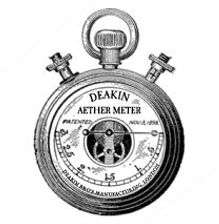
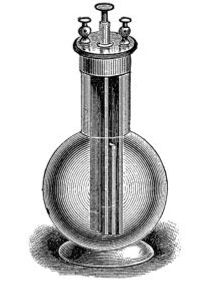
Archer Bowens answers, "Deakin traveled to Germany a number of times during the late 1870s, meeting frequently with a freshly educated physicist and mathematician named Max Planck. The young Planck was at the time involved in research relating to heat mechanics and thermodynamics." Bowens also notes, "It is significant to mention that in the years following World War II, both British and American intelligence services scrambled to track down any surviving Deakin optical devices because of rumored thermal imaging capabilities. A number of working Deakin-manufactured goggles had surfaced throughout the war, but by the time any were recovered during the late 1940s and early 1950s, the associated æther cells had all reportedly disintegrated."
- Paul D. asks: "As Geoffrey Hawkins appears to be the central figure of your efforts and studies, can you at least provide a little more biographical information about him? You have been somewhat lacking in that area so far."
You are correct Paul, but I would like to think that our motives in that regard are at least well intentioned. We feel that it is much more compelling and interesting to unfold the story of Geoffrey Hawkins via the contents of the strongbox as they are investigated and cataloged. Also, by attempting to construct too much of a biography of Hawkins at this point, we risk inaccuracies and contradictions that would most certainly undermine our long term goals and efforts. It is also important to note that even though we have presented the distinguished Mr. Hawkins as the central figure and namesake of our efforts, this history that we explore has a wide and varied cast of characters and it appears that the contents of the strongbox will reveal much, much more than the story of just one man.
CORRECTION: Relating somewhat to Paul's inquiry, we wanted to post a correction regarding information presented in The Mysteries of Duquesne (17 Jaunuary, 2010). In that post, I stated that Geoffrey Hawkins was born in London in 1850. I based this on information provided to me more than three decades ago by my grandmother Esme Sigismund Pepper. Archer Bowens has since informed me that while the date of 1850 is correct, Hawkins was actually born in Dixton near the town of Monmouth in south Wales. Archer notes, "One might wonder if Hawkins parents named him for Geoffrey of Monmouth, the famous 12th century clergyman who wrote the Historia Regum Britanniae, a largely fictional British history that was one of the first texts to mention King Arthur."